

The U.S. Departments of Health and Human Services (HHS) and Agriculture (USDA) have published Dietary Guidelines for Americans (DGAs) for nearly 50 years. The Dietary Guidelines for Americans form the basis for federal nutrition policy and provide advice on what to eat and drink to meet nutrient needs, promote health, and prevent disease. The report, which is updated every five years, also includes recommendations on consumption of distilled spirits, beer and wine.
The much anticipated new 5-year report, covering 2025 through 2030, has been released by Health and Human Services (HHS) Secretary Robert F. Kennedy Jr. and his key advisors. The Dietary Guidelines advise on what to eat and drink in order to promote health and meet nutritional needs for Americans. The full report is included below.
A Look at Reports from 1980 to 2030
We took a deep dive at the guidance from 1980 to 2030. Looking at half a century’s worth of guidelines we found quite a roller coaster ride of approaches to the recommendations. Like many government programs the initial 1980-1985 Dietary Guidelines for Americans – DGAs started out simple at a mere 11 pages. The 2020-2025 report ballooned to more than 164 pages and the new 2025-2030 guidelines shrunk back down to just 10 pages. Shocking right?
If you keep up with distilled spirits news, you know that the industry has been hit with many headwinds over the last couple of years with declining sales, a few plant closings and some workforce reductions. That’s why when the former U.S. Surgeon General in early 2025 suggested that he wanted to change the recommended consumption rate from two alcohol drinks per day for men and one for women to zero based on the possibility of a connection with an increase in seven types of cancer the beer, wine, and distilled spirits industries took notice. His suggestion about the recommendation early in ‘25 immediately sent stock prices of global beer, wine, and spirits brands down about 3%. That is when alcohol industry groups got together and created ScienceOverBias.com to make their position clear and question some of the proposed guidelines. Now that the new guidelines are out, the industry group is breathing a sigh of relief. After 50 years, the keyword for alcohol recommendations remains the same – moderation.
“These Guidelines return us to the basics,” said Health and Human Services (HHS) Secretary Robert F. Kennedy Jr. “American households must prioritize whole, nutrient-dense foods—protein, dairy, vegetables, fruits, healthy fats, and whole grains—and dramatically reduce highly processed foods. This is how we Make America Healthy Again.”
Here is a short summary of the new guidance with a simple sentence about alcohol.
The Guidelines emphasize simple, flexible guidance rooted in modern nutrition science:
- Prioritize protein at every meal
- Consume full-fat dairy with no added sugars
- Eat vegetables and fruits throughout the day, focusing on whole forms
- Incorporate healthy fats from whole foods such as meats, seafood, eggs, nuts, seeds, olives, and avocados
- Focus on whole grains, while sharply reducing refined carbohydrates
- Limit highly processed foods, added sugars, and artificial additives
- Eat the right amount for you, based on age, sex, size, and activity level
- Choose water and unsweetened beverages to support hydration
- Limit alcohol consumption for better overall health
Related Story – The recommendations on alcohol haven’t changed much since 1980 until the latest 2025 guidelines came out. Take a look at the evolution of the guidelines since their inception through 2025.
A Deep Dive on the Evolution of HHS & USDA Alcohol Guidelines for Americans from 1980 through 2025
What do the Dietary Guidelines Say About Alcohol?
More than half of American adults consume alcohol, and the majority do so responsibly and in moderation. Since the very first edition, the DGAs have recommended that adults who choose to drink should do so in moderation. Over the years, additional information has been added, such as the definition of what counts as one drink in 1985 and the definition of moderation as being up to 2 drinks a day for men and up to 1 drink a day for women in 1990. The current DGAs include recommend the following:
Adults of legal drinking age can choose not to drink, or to drink in moderation by limiting intake to drink 2 drinks or less in a day for men and 1 or less in a day for women, when alcohol is consumed. Drinking less is better for health than drinking more. There are some adults who should not drink alcohol.
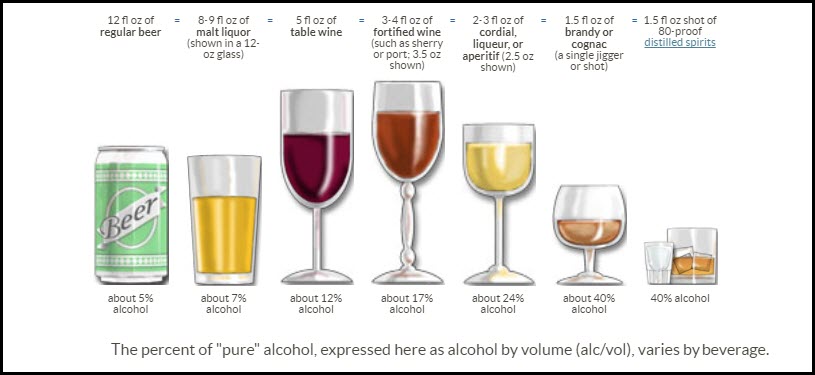
Since 1985 this is how the Dietary Guidelines for Americans identified one drink. This guideline has remained pretty much unchanged from 1985 through 2020 reports. This text has been removed from the 2025-2030 guidelines.
- 12 fluid ounces of beer (5% Alcohol by Volume [ABV])
- 5 fluid ounces of wine (12% ABV)
- 1.5 fluid ounces of distilled spirits (40% ABV)
Stay Informed: Sign up here for the Distillery Trail free email newsletter and be the first to get all the latest news, trends, job listings and events in your inbox.
The Science Over Bias Coalition, a broad coalition of the nation’s agriculture, beverage and hospitality industries, issued the following statement in response to the alcohol guidance in the new Dietary Guidelines for Americans, 2025–2030. A full list of the coalitions members is below.
“The Dietary Guidelines’ longstanding, overarching advice is that if alcohol is consumed, it should be done in moderation. These updated guidelines, underpinned by the preponderance of scientific evidence, reaffirm this important guidance.”
The group said the new guidelines are consistent with the 2020-2025 Dietary Guidelines for Americans (DGAs), which advised that “drinking less is better for health than drinking more” and that “there are also some people who should not drink at all.” The National Academy of Sciences, Engineering, and Medicine (NASEM) Consensus Report, which is the study directed by Congress to inform the 2025 Dietary Guidelines on alcohol, concluded in part that those who drink in moderation have a decreased risk of cardiovascular disease and a lower risk of all-cause mortality. The report also linked moderate alcohol consumption with an increased risk of breast cancer.
As a part of the new guidelines, explicit recommendations on drinks per day have been removed altogether. In response, Dr. Mehmet Oz, Administrator for the Centers for Medicare & Medicaid Services (CMS), commented that alcohol plays a role in a healthy lifestyle.
“Alcohol is a social lubricant that brings people together,” said Dr. Oz. “In the best-case scenario, I don’t think you should drink alcohol, but it does allow people an excuse to bond and socialize. And there’s probably nothing healthier than having a good time with friends in a safe way. If you look at the blue zones [regions with exceptionally long-lived populations], for example, around the world where people live the longest, alcohol is sometimes part of their diet.
“Again, small amounts taken very judiciously and usually in a celebratory fashion. So, there is alcohol on these dietary guidelines, but the implication is don’t have it for breakfast, right? (laughs) There should be something done a small amount with hopefully in some kind of an event that men have alcohol added. The general move away from two glasses for men, one glass for women, there was never really good data to support that quantity of alcohol consumption. That data was probably primarily confused with broader data about social connectedness.”
Update: After the press briefing, Dr. Oz clarified his, “… don’t have it for breakfast.” comment with a post on X.
“Brunch is obviously different than breakfast. (Yes, still keep to a minimum.),” said Dr. Oz.

What Does the 2025 – 2030 Dietary Guidelines for Americans Recommend for Alcohol?
In a surprising move for a government document, the guidelines have been simplified.

Limit Alcoholic Beverages
- Consume less alcohol for better overall health.
- People who should completely avoid alcohol include pregnant women, people who are recovering from alcohol use disorder or are unable to control the amount they drink, and people taking medications or with medical conditions that can interact with alcohol. For those with a family history of alcoholism, be mindful of alcohol consumption and associated addictive behaviors.
The guidelines on the per drink recommendations for men and women have been removed. That’s it, short and sweet. The full report is included below.
Who is the Science Over Bias Coalition?
The group is a broad coalition of the nation’s agriculture, beverage and hospitality industries including the following associations.
- American Beverage Licensees
- American Cider Association
- Associated Cooperage Industries of America Inc.
- American Craft Spirits Association
- American Distilling Institute
- American Distilled Spirits Alliance
- Beer Institute
- Brewers Association
- Can Manufacturers Institute
- Consumer Brands Association
- Distilled Spirits Council of the United States
- Glass Packaging Institute
- Hop Growers of America
- Independent Restaurant Coalition
- National Association of Wheat Growers
- National Barley Growers Association
- National Beer Wholesalers Association
- National Restaurant Association
- United States Bartenders’ Guild
- WineAmerica
- Wine Institute
- Wine & Spirits Guild of America
- Wine & Spirits Wholesalers of America
These trade associations have joined more than 85 organizations who have called for Science Over Bias in the Dietary Guidelines review process with respect to alcohol.
Please help to support Distillery Trail. Sign up for our Newsletter, like us on Facebook and follow us on Instagram and Twitter.